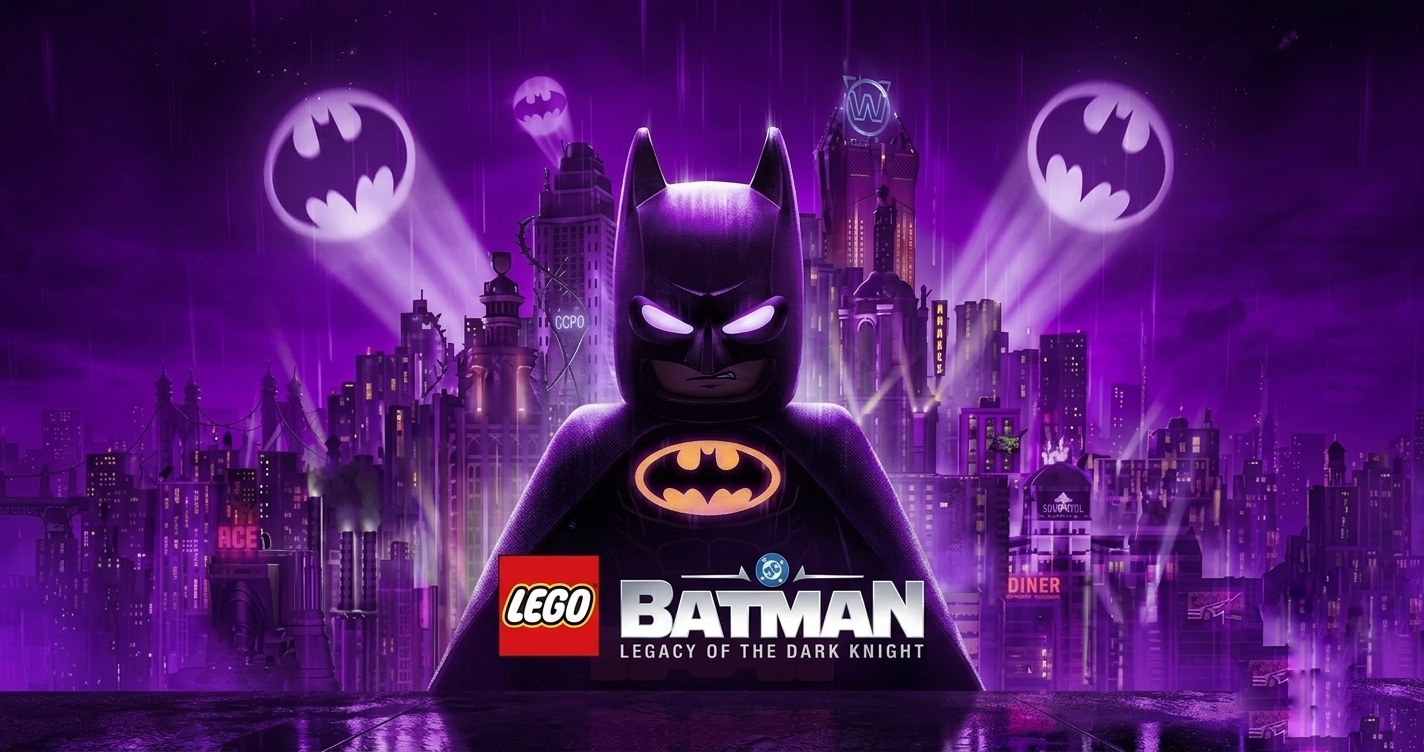
The Definitive Batman Story, Built Brick by Brick
Every generation deserves its own definitive Batman game, and TT Games has delivered exactly that with LEGO Batman: Legacy of the Dark Knight. Released on May 22, 2026 for PlayStation 5, Xbox Series X/S, and PC, this open world action adventure is not simply another entry in the beloved LEGO games franchise. It is a full scale celebration of 86 years of Batman history, a love letter to every film, television series, comic book, and video game that has shaped the Dark Knight into the cultural icon he is today. Developed by the award winning studio behind LEGO Star Wars: The Skywalker Saga, Legacy of the Dark Knight is the fourth installment in the LEGO Batman series and represents a bold new chapter for the franchise, arriving with a confidence and ambition that is impossible to ignore.
Notably, this is also the first LEGO game developed under new management at TT Games and the first entry in the franchise without the involvement of longtime creative force Arthur Parson. The pressure on this game to prove that the LEGO formula could evolve and expand was immense, and by virtually every measure, the new team has risen to that challenge magnificently.
The Story: From Bruce Wayne to Batman Across Six Chapters
What truly sets Legacy of the Dark Knight apart from every previous LEGO Batman title is the scope and emotional intelligence of its narrative. The game is structured around a prologue and six distinct chapters, each one representing a different phase in Bruce Wayne’s journey and paying homage to a different era of Batman media. The result is a story that feels simultaneously epic in scale and deeply personal in execution.
The prologue opens not in Gotham City but in Nanda Parbat, where a young Bruce Wayne trains under the League of Shadows alongside Talia al Ghul and Ra’s al Ghul. This immediately signals that Legacy of the Dark Knight is playing for keeps. Rather than dropping players straight into a fully formed Batman, TT Games wants you to earn the cowl. The training sequences introduce the game’s mechanics gradually and in a way that feels narratively justified, teaching players what it takes to become a hero before asking them to be one.
From there, the prologue blends the Crime Alley tragedy from Tim Burton’s 1989 film with Batman Begins-era ninja training in a way that PC Gamer described as a gleeful mashup of cool moments from various films smooshed together like a kid’s sandwich. This playful mixing of canonical moments from different adaptations is the game’s storytelling superpower, and TT Games deploys it with remarkable skill throughout every chapter that follows.
Chapter One returns Bruce to Gotham City and follows his earliest attempts to bring justice to a city drowning in crime. The tone here is grounded for a LEGO game, with Batman operating cautiously against street level threats including the Red Hood Gang. Jim Gordon is introduced as a crucial ally, and the partnership between the two characters provides both comedic and genuinely touching moments. Each chapter introduces a new companion, and the game uses these introductions thoughtfully. Alongside Gordon in Chapter One, players also begin to encounter the wider network of allies that will eventually become the extended Bat family.
The middle chapters are where the narrative hits some uneven ground. Chapters Three and Four have been noted by several reviewers as feeling somewhat padded compared to the tighter storytelling surrounding them. However, they serve a meaningful purpose in showing Batman’s growth as a protector, his struggles against threats like Mr. Freeze alongside Batgirl, and the gradual evolution of Dick Grayson from Robin into Nightwing.
Chapter Five is widely regarded as the game’s narrative peak. Batman travels to Arkham Asylum to question the Joker in a sequence that begins as a near recreation of the iconic opening of Arkham Asylum before brilliantly pivoting into a hilarious spoof of The Dark Knight’s legendary interrogation scene. It then escalates further into an Arkham prison break mixed with a Scarecrow hallucination sequence, all within a single mission. It is the kind of bold, creative storytelling that could only come from a team given full creative freedom to draw from every source imaginable, and it represents LEGO Batman at its absolute best.
The final chapter and closing boss fight are described by Game Informer as particularly exciting, with the story altering expected narrative twists to deliver an original conclusion rather than simply retelling something players have seen before. This commitment to forging a new story out of beloved building blocks is what elevates Legacy of the Dark Knight above being a simple nostalgia trip.
Gameplay: Combat, Detection, and the Art of Being Batman
The gameplay in Legacy of the Dark Knight represents the most substantial evolution the LEGO Batman series has ever undergone. At its core, the game features roughly 20 linear story missions in which Batman fights, detects, and solves crimes alongside a partner. Each mission is built around a combination of combat encounters, environmental puzzle solving, and investigation sequences, ensuring the pacing remains varied and the gameplay never feels repetitive.
The combat system is the headline mechanical achievement. TT Games brought in select developers from Rocksteady, the studio responsible for the beloved Batman Arkham Trilogy, to help shape the fighting. The result draws heavily from Arkham’s celebrated freeflow system but has been thoughtfully adapted to feel more approachable for players of all ages and skill levels. Rather than demanding precise counters and technical mastery, Legacy of the Dark Knight encourages players to combine fluid combo chains, gadget usage, environmental interactions, and stealth techniques in creative ways. The combat feels genuinely satisfying rather than merely functional, which is a major step forward for the franchise.
Batman’s arsenal includes upgraded Batarangs, the Batclaw, foam sprayers, and various other tools that find both combat and puzzle solving applications throughout the game. Companion characters each bring their own distinct set of gadgets that open up new puzzle solutions and side activities in the open world, making the completion of main story missions all the more rewarding. Catwoman’s lock picking skills, Gordon’s police credentials, and Robin’s acrobatic abilities all feel genuinely useful rather than superficially differentiated.
The detective elements are a welcome and fitting addition to the Batman fantasy. Between combat encounters, players scan environments for clues, piece together crime scenes, and investigate mysteries scattered across Gotham. The puzzles are not particularly demanding and are designed to be accessible to a broad audience, but the detective framing fits Batman so naturally that even straightforward puzzle sequences feel satisfying. As one reviewer noted, when puzzles require building new structures from scattered LEGO bricks to progress, the playfulness of the format actually enhances rather than undermines the detective atmosphere.
Traversal across Gotham is handled through a combination of grappling hooks, gliding, and ground based movement that feels fluid and intuitive. Getting from rooftop to rooftop or from street level to the city’s highest peaks is effortless, and the animation work on Batman’s movements is among the best seen in the LEGO series to date. The Batmobile and Batcycle collection adds a vehicle dimension to traversal that ranges from leisurely city cruises to high speed villain chases, with the legendary Tumbler from the Nolan trilogy standing out as a particularly thrilling ride.
For players seeking a serious challenge, the Dark Knight Mode difficulty strips away the safety nets that typically cushion LEGO game experiences, offering an unforgiving test that demands genuine mastery of the combat and traversal systems. It is a smart addition that extends the game’s appeal well beyond its family friendly default presentation.
Open World Gotham: Four Islands of Endless Discovery
The open world is arguably the game’s single greatest achievement. Gotham City is divided across four accessible islands, each unlocking progressively as players advance through the main campaign. Rather than dumping the entire world on players at once, Legacy of the Dark Knight introduces each area at a pace that allows Gotham to feel genuinely discovered rather than simply accessed. The four areas, Tricorner Island, South Island, Central Island, and North Island, each carry their own architectural character and density of content.
Game Informer’s review described the open world as dynamic and organic across its four islands, full of diverse architecture, pedestrian and vehicle traffic, and virtually every Batman related landmark a fan could hope for. The city is built with Batman’s verticality firmly in mind, with puzzles and collectibles scattered not just across the streets but across the skyline itself. Looking up is always rewarded. Gliding between skyscrapers in pursuit of a collectible or navigating a rooftop puzzle while Gotham’s perpetual rain falls below creates an atmosphere that very few superhero games have managed to capture.
The side content populating this open world is where completionists will lose themselves for dozens of hours. Batmobile races challenge driving skills across Gotham’s streets. Crime scene investigations inspired by the Witcher series task players with piecing together clues scattered across districts. Tracking missions send Catwoman into restricted areas. AR challenge missions break down into combat, traversal, and driving categories. Wild animal tracking activities require placing trackers on Gotham’s surprisingly robust urban wildlife. Wanted poster puzzles ask players to identify suspects by piecing together visual clues. The variety is genuinely impressive and ensures the open world never feels like a checklist of identical tasks.
One review noted that there are hundreds of puzzles and short sidequests appearing on the map as the campaign progresses, and that a full playthrough clocked in at roughly 15 hours while still leaving a significant portion of the content undiscovered. Reaching 100 percent completion will require considerably more investment, which is exactly the kind of depth LEGO game fans have come to expect.
The Batcave: A Hub Worth Coming Home To
The Batcave serves as Legacy of the Dark Knight’s central hub, and TT Games has transformed it into one of the most rewarding spaces in the entire game. It becomes fully accessible at the beginning of Chapter Two, and its various sections expand and grow as players progress through both the main campaign and the open world.
Within the Batcave, players have access to a garage housing the growing collection of Batmobiles and Batcycles, a fully featured outfit storage area for the extensive Batsuit collection, a crime lab for reviewing investigation case files, and the iconic Batcomputer complete with a red Bat Phone. The customisation system allows players to decorate the cave with trophies and collectibles gathered throughout Gotham, and dedicated fans will find it deeply satisfying to watch the space fill with references to decades of Batman history. Players can even construct the giant dinosaur trophy that has appeared in various Batman stories over the years.
The Bat-Mite Store, run by the fifth dimensional imp himself, offers a continuously expanding inventory of items purchasable with LEGO studs collected throughout the game. Each item comes with its own humorous description, and the store’s selection provides a constant incentive to keep exploring and collecting. Red Bricks, found throughout the open world, unlock additional modifiers and even alternative colour schemes for playable characters, adding another dimension of personalisation to an already deeply customisable experience.
The Batsuit Collection: 30 Plus Iconic Suits Spanning 86 Years
No review of Legacy of the Dark Knight would be complete without acknowledging the extraordinary Batsuit collection, which spans over 30 iconic designs drawn from across Batman’s entire multimedia history. Every major live action film is represented, from Michael Keaton’s sculpted 1989 armor to Val Kilmer’s Sonar Suit from Batman Forever, the chrome plated Ice Armor from Batman and Robin, Christian Bale’s Dark Knight trilogy suits, and Robert Pattinson’s tactical grey and black costume from The Batman.
Animation and television receive equally thorough treatment. Adam West’s Batman 66 suit brings a burst of campy joy to the game, while Batman: The Animated Series and Batman: The Brave and the Bold both contribute their iconic looks. The Arkham Trilogy Pack, Batman Beyond Pack, and various comic inspired suits including the Golden Age design, the Rainbow Batman costume, and the Gotham by Gaslight Victorian suit ensure that every type of Batman fan will find their favourite represented somewhere in the collection. An entirely original game exclusive suit with glowing eyes and a glowing chest symbol rounds out the vault as a beautiful symbol of the game’s own identity within the broader legacy.
Presentation: A Gotham That Feels Alive
Visually, Legacy of the Dark Knight is a genuine showcase for what the LEGO aesthetic can achieve on current generation hardware. Gotham City is rendered with an atmospheric moody quality, its perpetual rain soaked streets gleaming under neon light, while the LEGO construction of every building, vehicle, and character is lovingly detailed to a degree that rewards close inspection. TT Games has described the visual development as building Batman’s world brick by brick, and the care invested in that process is evident in every frame.
The game is packed with Easter eggs that span the full breadth of Batman’s history, referencing films, comics, animated series, and games in ways that will reward both casual viewers and obsessive fans. As one reviewer described it, the experience of playing Legacy of the Dark Knight involves constantly pointing at the screen in recognition, discovering references that range from immediately obvious to genuinely deep cut obscurities.
The LEGO humor throughout is characteristic of the series at its best, finding comedy in the absurdity of translating dramatic Batman moments into plastic brick form without ever undercutting the genuine emotional weight of the story being told. Moments involving shark repellent bat spray, Batman covered in LEGO bat droppings, or Bat-Mite’s store inventory descriptions provide consistent laughs that ensure the game remains accessible and enjoyable for the youngest players while never patronising older fans.
Where the Game Falls Short
No review would be complete without acknowledging the game’s few genuine weaknesses. The stealth mechanics are the most frequently cited criticism across multiple reviews. Despite the game offering the option to sneak past groups of enemies, the enemy detection system is basic enough that threats only register player presence when Batman steps directly into their line of sight. This makes stealth feel more like an afterthought than a meaningful tactical option, and it also means that some open world side puzzles tied to stealth upgrade crates are easier to miss entirely.
The mid game chapters, specifically Chapters Three and Four, represent a noticeable dip in story momentum compared to the tighter, more inspired sequences surrounding them. The puzzle difficulty in story missions has also drawn comment from reviewers who feel they are somewhat too forgiving, occasionally hand holding players toward solutions in ways that underestimate the audience’s ability to figure things out independently. Open world puzzles are generally more satisfying in this regard and offer a greater sense of genuine achievement.
Minor physics related bugs have been reported across the game’s roughly 15 hour main campaign, though these are described as scarce and have not significantly impacted the overall experience for most players.
Final Verdict: A Landmark Achievement for Batman and LEGO Games Alike
LEGO Batman: Legacy of the Dark Knight earns its title in every sense. It takes Batman’s journey seriously enough to build a narrative arc that genuinely moves through phases, from a frightened young man learning to fall in a mountain training camp to Gotham’s immortal protector standing at the top of a city he has spent his life defending. It honours 86 years of Batman history not merely by referencing it but by weaving it into a new original story that feels worthy of the mythology. Its open world Gotham is a genuine achievement in atmospheric game design, its combat systems represent a meaningful leap forward for the LEGO franchise, and its Batcave customisation hub gives players a reason to invest deeply in everything the game has to offer.
Whether you grew up watching Adam West on television, falling in love with Kevin Conroy’s voice work in the animated series, experiencing the revelation of the Arkham games, or discovering the character through Robert Pattinson’s recent reinvention, this game was made for you. With a 96 percent positive rating on Steam from over 3,500 user reviews at launch, the players have delivered their verdict clearly. Legacy of the Dark Knight is not simply one of the finest LEGO games ever made. It is one of the finest Batman games ever made, full stop.